


Try Notetracks Today!
The platform for creators to review and collaborate on their audio projects.
 Start Free


Share
A podcast script doesn't mean reading every word. For most shows it's a running order: what you'll say to open, the segments in order, the questions or talking points, the ad reads and how you'll close. Write out the parts that need to be exact, and leave bullet points for the rest so you still sound like yourself.
Below are three free podcast script templates you can copy and paste (interview, solo and co-hosted), intro and outro scripts, and a full example script.
SHOW: [Show name] — Episode [#]: [Title]
GUEST: [Name], [role / company]
TARGET LENGTH: [e.g. 35 min]

COLD OPEN (0:00–0:30)
[Best quote from the guest, pulled after recording]

INTRO (0:30–1:30)
"Welcome to [show]. I'm [host]. Today I'm talking with [guest], who [one-line credential]. We get into [topic 1], [topic 2] and [the surprising thing]."

WARM-UP (1:30–4:00)
- How did you get into [field]?

SEGMENT 1: [Topic] (4:00–15:00)
- Question 1
- Question 2
- Follow-up if they mention [X]

AD READ / ANNOUNCEMENT (15:00–16:00)
[Write it out word for word]

SEGMENT 2: [Topic] (16:00–28:00)
- Question 1
- Question 2

RAPID FIRE (28:00–32:00)
- [3–5 short questions]

OUTRO (32:00–35:00)
"Where can people find you?"
"Thanks to [guest]. If you liked this, [one call to action]. Next week: [tease]."
SHOW: [Show name] — Episode [#]: [Title]
THE ONE TAKEAWAY: [What listeners should remember]
TARGET LENGTH: [e.g. 20 min]

HOOK (0:00–0:45)
[A question, a stat or a short story that sets up the problem]

INTRO (0:45–1:30)
"I'm [host], and this is [show]. Today: [topic], and by the end you'll know [takeaway]."

POINT 1 (1:30–7:00)
- Main idea
- Example or story
- What to do with it

POINT 2 (7:00–13:00)
- Main idea
- Example or story
- What to do with it

POINT 3 (13:00–18:00)
- Main idea
- Example or story
- What to do with it

RECAP + CALL TO ACTION (18:00–20:00)
"So: [point 1], [point 2], [point 3]. If you try this, [call to action]. Next time: [tease]."
SHOW: [Show name] — Episode [#]: [Title]
HOSTS: [Host A] (leads), [Host B]
TARGET LENGTH: [e.g. 45 min]

OPEN (0:00–2:00)
A: "Welcome to [show], I'm [A]."
B: "And I'm [B]."
A: "Today we're [topic]."

CATCH-UP (2:00–5:00)
- One thing each host did or noticed this week

MAIN TOPIC (5:00–25:00)
- A sets up the topic
- B's take / counterpoint
- Listener question or example

BREAK / AD READ (25:00–26:00)
[Word for word, assigned to A or B]

SECOND TOPIC (26:00–40:00)
- Talking points

WRAP (40:00–45:00)
- Each host's one takeaway
- Call to action and next week's tease
"Welcome to [show name], the show about [topic] for [audience]. I'm [host]. Every week we [what you do]. Today, [episode hook]. Let's get into it."
"That's it for this episode of [show name]. If it helped, [one call to action: follow, review, share with a friend]. Show notes and links are at [website]. Next week, [tease]. See you then."
Keep the intro under a minute, and give the outro one call to action, not five.
Here's a short example of an interview-show opening, filled in:
COLD OPEN
JESS: "We went from six hours of editing down to ninety minutes."

INTRO
SAM: "Welcome back to The Signal Chain. I'm Sam, and today I've got Jess Calloway in the studio. Last time she was on, she was cutting everything in one room on one mic. Today: what changed when she switched to separate tracks, and why transcript search became her biggest time-saver."

SEGMENT 1: THE OLD WORKFLOW
- What did a typical edit look like back then?
- Where did the hours actually go?

SEGMENT 2: THE SWITCH
- What made you move to separate tracks?
- What surprised you?
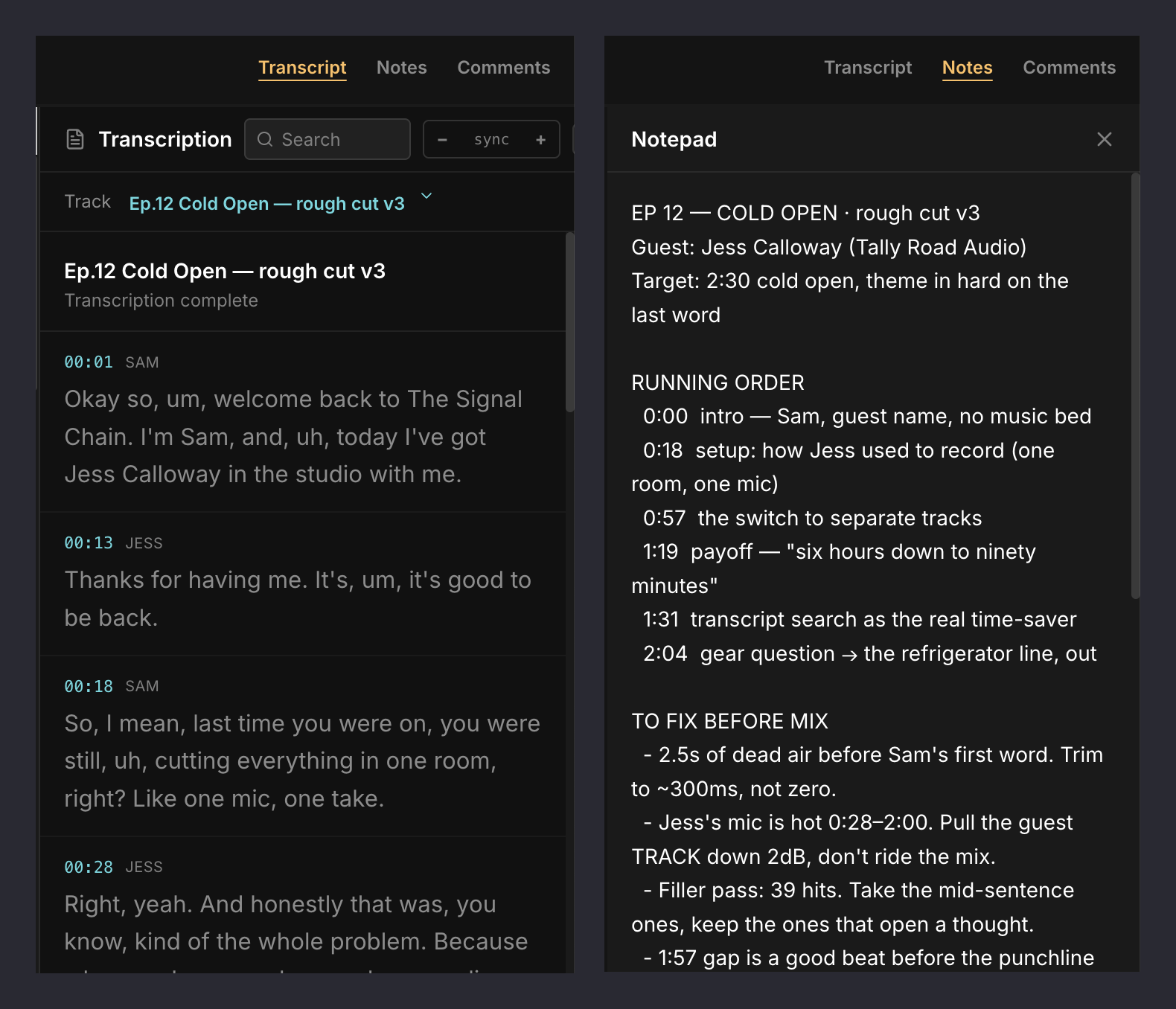
Once the episode is recorded, the script turns into the edit plan. In Notetracks, you can paste the running order into the project's notepad, right next to the audio, then get a timestamped transcript of the recording to check it against the script. Your co-host, producer or client leaves notes on the exact moment that needs fixing.
Writing fiction or audio drama? See how audio drama teams use Notetracks to give direction on every take.

Be the first to know about the latest news, posts and features.


